Showing posts with label Dorothy St. James. Show all posts

Friday, November 4, 2022

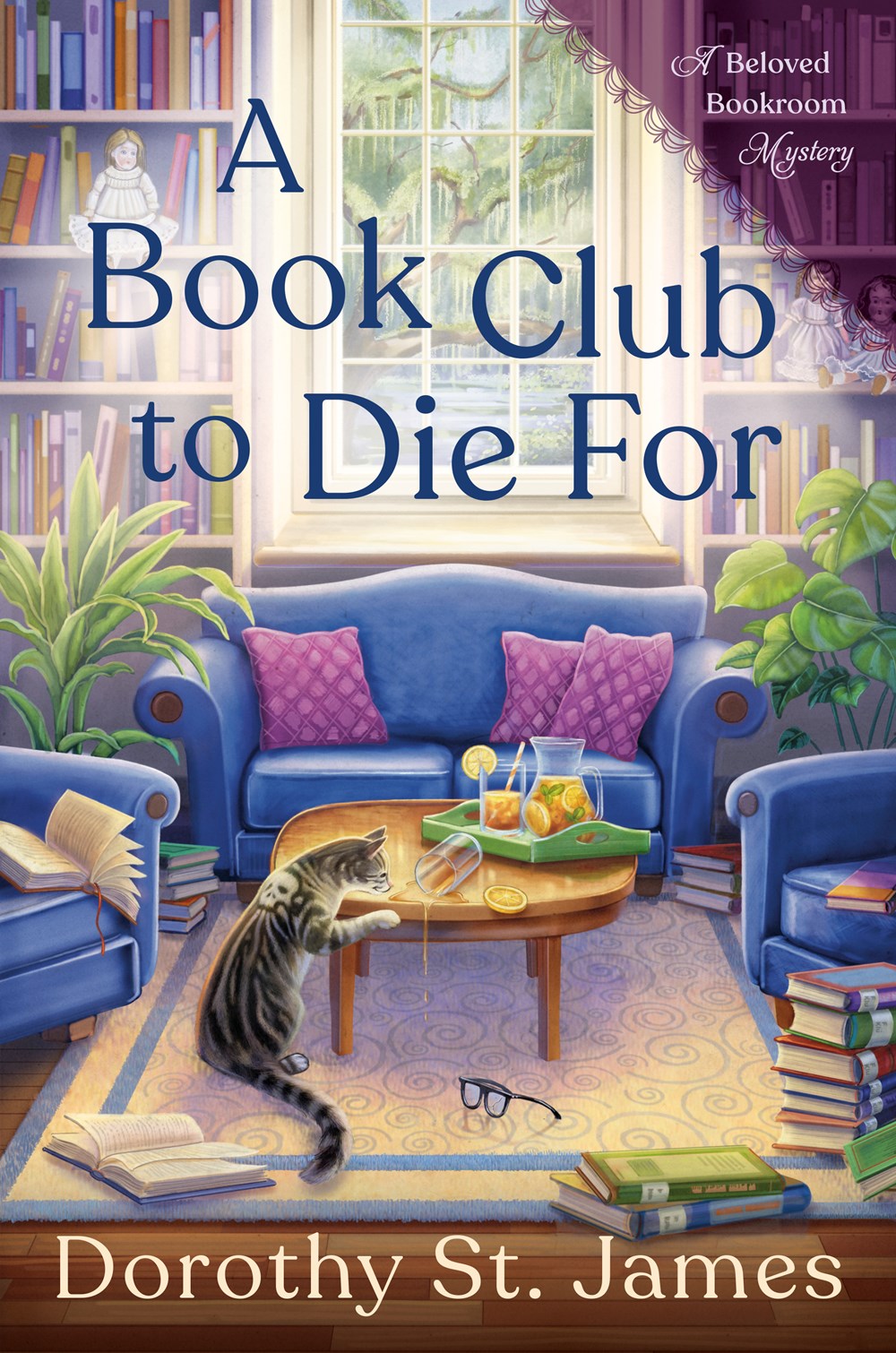
#Review - A Book Club to Die for by Dorothy St. James #Mystery #Cozy

Series: A Beloved Bookroom Mystery (#3)
Format: Hardcover, 304 pages
Release Date: November 1, 2022
Publisher: Berkley Books
Source: Publisher
Genre: Mystery / Cozy

When a member of an exclusive book club is checked out, spunky librarian Trudell Becket must sort fact from fiction to solve the murder.

The Cypress Arete Society is one of the town’s oldest and most exclusive clubs. When assistant librarian Trudell Becket is invited to speak to the group about the library, its modernization, and her efforts to bring printed books to the reading public, her friend Flossie invites herself along. Flossie has been on the book club’s waiting list for five years, and she’s determined to find out why she’s never received an invitation to join. 

But not long after Tru and Flossie arrive for the meeting, they’re shocked to find the club’s president, Rebecca White, dead in the kitchen. Rebecca was a former TV actress and local celebrity, but was not known for being patient or pleasant. She’d been particularly unkind to the book club’s host for the evening, who also happens to be the mother of Detective Jace Bailey, Tru’s boyfriend. And Rebecca had made it clear that she didn’t think Flossie was book club material.

With her boyfriend and one of her best friends wrapped up in a murder, Tru has to work fast to figure out who cut Rebecca’s story short before the killer takes another victim out of circulation....

A Book Club to Die For is the third installment in author Dorothy St. James' A Beloved Bookworm Mystery series. Trudell (Tru) Beckett and her Scooby-Doo mystery book club friends are back in a story that is filled with twists as a former Hollywood star is found dead, and Tru once again proves that even a well read librarian who loves mysteries can sometime see what others can't see. Tru, while assistant librarian in the fictional town of Cypress, South Carolina, has successfully embarked on a secretive project where she saved as many library books as she could before they were sent to the county dump for disposal. 

Over the previous two books, Tru has solved two different murders, and is now in the public eye which really grates on the Chief of Police's nerves. Everyone is wondering what she will do next, which is likely the reason why she gets a coveted invitation to the Cypress Arete Society where she is to give a presentation about her knowledge of books. When she and her friend Flossie arrive early, they discover Rebecca White, who is the club president, moving furniture and harassing this month's hostess over food choices. Things spiral out of control when Tru finds Rebecca dead, and the questions begin immediately.

Would Flossie kill Rebecca over her slight at not getting an invitation? Who had the means and the opportunity if not for Flossie and Hazel? Why would anyone kill Rebecca who was supposed to be happy living in Cypress? And, where has her boyfriend Jace been spending his nights? Jace asks Tru to do her own investigating and find out who really killed Rebecca which leads to lots of possibilities since Rebecca wasn't very well loved. She was an actress on a soap before she quit and came to Cypress where she has been busy throwing her weight around and making people uncomfortable.

For Tru, this means trying to gain the trust of the Arete Society members, while trying to help Hazel from going to prison for murder. Hazel, who is one of the best cooks in Cypress and wouldn't harm a fly, let alone kill someone out of spite or anger, may have been the last person to see Rebecca alive. If that wasn't enough fun, for almost a year, Tru has been hiding a secretive library in the basement of the library where she works. She carries a book bag with books she believes people would like to read. This is happening right under the nose of her boss, Lida Farnsworth, who just happens to be a member of the Arete Society.

What's most interesting about this book is the participation of one Dewey Decimal. Dewey, the cat on the cover of the book, always tags along with Tru when she goes to work and hangs out in the secretive Bookworm library. Dewey, it seems, has been trying to give Tru hints from almost the first moment Tru decides to figure out who the murderer is so that Jace doesn't lose his job. Sorry folks, but cats are smarter than you give them credit for. In this case, Dewey's hints may save Tru and her friends from becoming the next victim. 

So, Tru's plate is filled with finding a killer, dealing with a robotic librarian that keeps attacking people, a father who disappeared, a mother who thinks Tru needs to get a better diet, and a cat who pretty much puts the reason for the murder right in front of Tru's face before she finally puts the clues together. I am happy to report that one of my worries about Lida finding out what Tru has been up to, has been dealt with. I think that you will like this series. It's got the Southern small town feel, the sarcasm that southern ladies tend to have when they speak together, and possibly a new beginning for Tru and Jace.


Chapter One

Librarians are keepers of knowledge, caretakers of truth, and sowers of wisdom. Many of us rush out to share the world with our communities with the enthusiasm of a child who has suddenly mastered a new skill. We want people to know, to know . . . well, everything.

This is our mission. This is our passion.

We are the bringers.

We are the beacons cutting through the darkest of nights.

I should be thrilled to be able to provide this service to the Arete Society, the town's most influential book club. So why did I have this sudden desire to turn around, march back to my car, and drive home as fast as my old Camry would take me?

I'd been asked to give a presentation. I'd been tasked with sharing my knowledge of books and my experiences working at the library with a group of ladies who love books as much as I do. I lived for moments like this.

Didn't I?

Usually, yes.

But.

Not.

Tonight.

"Trudell Becket, what's got you dragging your feet like this?" Flossie Finnegan-Baker turned her wheelchair toward me. "I do believe a cornucopia of slugs just passed us."

"Cornucopia? Of slugs?" I asked. That couldn't be right. But before she could explain that a group of slugs was indeed called a cornucopia, I said, "Never mind." Flossie was rarely wrong when it came to grammar and etymology. Besides, slugs weren't important. "This," I said. "This is a mistake." I felt the truth of it like a stone in my gut. I stood in the middle of the long, winding sidewalk leading up to Hazel Bailey's front porch and scrunched my eyes closed. "I shouldn't be here."

"You're suffering from a case of the jitters." My friend touched my hand. I looked at her, and she smiled encouragingly at me. Flossie had dressed for the book club meeting in muted shades of turquoise and tan. The colors spiraled together on her long, homemade tie-dyed dress, but it was quite a shift from the bright (and often) clashing colors she usually wore. She'd attached a large golden pin in the shape of Edgar Allan Poe's face to the collar of the thick white button-up sweater she'd worn over her dress. "Honey, even I get the jitters every time I do something new. Everyone does. That's why you brought me. To have your back. And I do. I've got your back. And you've got this. Let's go."

Our host lived at the edge of town in the middle of a forest of cypress trees that gave the town its name. The cypresses' silvery trunks stood tall and straight, like the spines of books on a shelf, gleaming in the fading embers of the sunset.

Books were the reason I'd been asked to speak to the Arete Society. And those same books were the reason I couldn't go through with it.

Sure, I'd been excited at the opportunity to share my experiences working as an assistant librarian. Nearly as excited as Flossie was now. My friend started spinning pirouettes with her wheelchair on the sidewalk in front of me.

This invitation meant that finally the town was taking me and my work at the library seriously. Finally, the townspeople saw me. And most of them even knew my name.

"Tonight! Tonight!" Flossie sang happily. "Tru, you do know what an honor it is to be here tonight, don't you?"

I did.

The Arete Society wasn't simply a book club. It was known throughout the state as the best and most prestigious book club. They rarely invited anyone outside their membership to speak at their meetings. Being asked to make a presentation was like being invited to dine at the governor's mansion. No, this was better. The current governor was rather unpopular.

It wasn't until we were walking up to the house that it had hit me.

"Rebecca invited me to talk about my work with the books at the library," I said, still unwilling to move any closer to Hazel's house.

"Yes, dear." Flossie tilted her head and gave me a searching look. "I know why we're here. That's one reason why it's so exciting."

"Yes, but Rebecca wants me to talk about my work with the books at the library." I shivered in the cool January air. Even though Cypress was in the middle of balmy South Carolina, it still experienced occasional winter cold snaps. A sharp northern breeze rattled the branches in the trees above us. "I shouldn't have agreed to come."

"Oh, go on with you. I'm sure you can steer the conversation," Flossie said, now grinning like a teen going out on her first date. This was really a big night for her.

But could I pull it off? Most of my work at the library was a secret. While half of the book club members were in on the secret, the other half had no idea I'd set up an unauthorized bookroom in the library's basement.

"Just talk about why you carry around that tote bag of yours and dodge any questions about where the books came from," Flossie suggested.

"That's not going to work. I shouldn't have even brought the tote bag. What is wrong with me? I'd been so dazzled by the invitation that I completely ignored the problem with my being here." I held up the tote bag as if it were filled with explosives.

It wasn't.

I'd filled the canvas tote with books I thought the ladies attending tonight would enjoy.

"I don't understand. You're a modern-day book-hauling Robin Hood," Flossie said. "That's something you should be proud of. That's something to be celebrated."

"I can't be here because of Lida Farnsworth." My boss. My intimidating boss, who was possibly the cleverest woman in town. Cypress's head librarian had been a member of the Arete Society for longer than anyone could remember. "I'd forgotten that she would be here. Well, I knew she would be here, but I didn't stop to consider what her listening to my talk might mean."

"So? She should be just as proud of you as I am." Flossie still didn't get it.

"When I start to hand out the books from my tote bag, Mrs. Farnsworth will recognize them as library books. You know, the same library books that were supposed to have been removed from the library? If she ever discovers I converted her library's basement into a secret bookroom without her consent, I will be out of a job before you can say 'Bob's your uncle.'"

"That's a funny phrase, 'Bob's your uncle.' Not awfully common in the United States. It's Irish in origin, so I suppose it shouldn't be too surprising we say it here in Cypress. After all, several of our town's founders arrived here from Ireland. According to my research, the phrase arose in the late 1880s, when British Prime Minister Robert Cecil appointed his nephew to the post of chief secretary for Ireland. The Irish were quite unhappy with this act of nepotism. And that's how people started saying 'Bob's your uncle' whenever anything was sure to happen. The man had literally been given the post because Bob was his uncle."

I usually enjoyed Flossie's impromptu etymological musings. But right now, I was in full panic mode. I didn't want to lose my job. Working at Cypress's public library was my life. I considered taking the tote bag back to the car. But that wouldn't work. I already had a reputation for carrying that tote bag everywhere. Not bringing it to the book club would invite more questions, not fewer. And when I stood up in front of the book club and someone asked me about the books I lent out, what in the world was I going to say?

I needed to get out of there.

My friends and I had started the secret bookroom a year ago, after Cypress's town leaders had hatched what they'd called a "brilliant" idea. It was, in truth, the worst idea ever. They had decided to modernize the library and create a bookless technological center to impress the kind of high-tech industries the town manager had wanted to woo.

Yes, the town desperately needed higher-paying jobs, but the idea of getting rid of our books still rankled. How could anyone want to transform our beautiful library into a place that had no books? None. Zip. Zero. Apparently, the town manager at the time had read articles about libraries that had gone all-electronic. He had fallen in love with the idea.

With the town manager leading the way, the mayor and council members ordered all the hold-in-your-hands printed books removed and replaced with ebooks. It broke my heart to see it happen.

Books provide escape, comfort, and knowledge. Sure, ebooks could do the same thing. But there was something magical about wandering through a library and stumbling upon the perfect book without ever realizing you were looking for it in the first place.

I had no choice but to do something to save the books that had been boxed up as if they were worthless tchotchkes collected by a distant relative who'd recently passed.

Before the boxes and boxes of books could be carted off, my friends and I moved as many as we could handle into the library's basement, where we set up an unofficial (and super-secret) bookroom. Only residents who could be trusted to keep their grandmother's best secret recipes were invited.

Upstairs, the library became a shining example of cutting-edge services.

Down in the basement, we turned back time and started using old-fashioned card catalogs and hand-stamped due dates on paper book slips for checked-out material.

I hated that we couldn't invite everyone into the basement bookroom's stacks. That was why I had started carrying around the tote bag filled with books I thought people needed. My plan had been working out quite well . . . until Rebecca White, former TV soap star and current president of the Arete Society, invited me to give a presentation to the book club. Silly me had immediately agreed.

"You've got this, Tru." Flossie patted my arm. "Just keep the facts vague, and everyone will leave happy."

"Keep the facts vague, even when someone asks me a direct question, like where all these books are coming from?" I shivered again. This was not going to work.

"If things get sticky, I'll cause a distraction. I promise."

"Is that why you invited yourself along? To create a scene when someone wants me to talk about our secret bookroom?"

She beamed a wide smile that showed off her straight, white teeth. "Friends lend each other courage. That's why girlfriend weekends always turn wild . . . from all that courage being passed around." She patted my arm more forcefully. "Now, let's get in there. I can already smell something savory and wonderful coming from the house. I've heard that the hostesses at these meetings always try to outdo themselves with the dinners they serve." She smacked her lips. "I aim to discover if that's true."

Remember that time Flossie and I broke into the library in the dead of night? My adventurous friend wasn't nearly as excited then as she was now.

Don't get me wrong. I understood why she was bubbling over like a washing machine with too much soap. Flossie had been on the waiting list for membership in the Arete Society for five years now. Three ladies' applications had been accepted ahead of hers. One of them had only moved to town last year, which had hurt Flossie worse than if someone had stabbed her in the heart. Although she refused to come out and say it, I knew she had wanted to accompany me tonight so she could quiz Rebecca about what she could do to win the group over.

"'Arete' is a term the founders back in the 1930s adopted from the ancient Greeks," Flossie said, speaking as if in a rush to get all the words out at once. "It means 'knowledge is the highest virtue.' I've always thought that was a clever name for a book club. Don't you agree, Tru? Isn't it clever?"

"Um . . . yes, clever." I knew the meaning of the word from an Intro to Latin class in high school, but really, I was more concerned about the tote bag (or should I say albatross) hanging from my arm. Even if arriving without it did cause people to ask questions, I needed to get it back to the car. I couldn't give Mrs. Farnsworth the opportunity to look at those books too closely. "I need to get rid of these library books. I'll be right back."

"Be a dear and grab an umbrella while you're at the car. I think I just felt a raindrop," she called after me.

The Baileys' sprawling ranch home with its oversized stone porch columns was one of Cypress's most talked-about residences. It also had one of the longest twisty sidewalks I had ever encountered. It took forever to jog to where we'd parked at the curb and then to jog back to where Flossie was waiting. Even though the air had a chill, a bead of sweat had trickled down my back by the time I was done with that little footrace of mine.

I fanned myself with my hand and hoped my cheeks weren't as red as they felt. The silvery Spanish moss weighing down the tree limbs above my head seemed to wave back.

"Flossie, I don't know if I can pull this off. Deception isn't something-"

"Pshaw! You've been practicing your speech for days now. And besides, you do these all the time."

Was Flossie serious? "I never-"

"Your programs at the library are super popular!" she practically shouted.

"This isn't the same thing. I'm in charge of children's programming. My audience is rarely older than five. These women"-I pointed toward Hazel's door in the distance-"they scare me."

"They're simply children who grew up. Heck, most of them still act like spoiled tots," Flossie scoffed. "And they asked you to come and speak to them, I might add. They've never asked me."

Flossie, who was forty years older than my thirty-eight, explored mountains, pushed her way through exotic jungles, and wrote best-selling novels under a pseudonym she refused to divulge. And she'd done all this while using a wheelchair. Just last week she bought a speedboat with the royalty check she'd received from her publisher. The year before, she'd used her royalty check to purchase and customize a cherry-red Corvette so she could speed around town using hand controls.

No one could deny that Flossie had stories to tell. Plus, she had an electric personality that made whatever she said sound exciting. The more I thought about it, the more I had to agree with her that her exclusion from the Arete Society seemed suspect.


Tuesday, October 25, 2022

#Review - A Perfect Bind by Dorothy St. James #Mystery

Series: A Beloved Bookroom Mystery (#2)
Format: Hardcover, 304 pages
Release Date: September 28, 2021
Publisher: Berkley Books
Source: Library
Genre: Mystery / Cozy

Librarian Tru Beckett, ardent defender of the printed word, is about to find out that keeping murder checked out of her beloved library is much harder than she thought...

Tru Beckett succeeded in building a secret book room in her now bookless library, where book lovers from lovely Cypress, South Carolina, can rejoice in the printed word. Now she's working hard to maintain the little library downstairs while keeping her "real job" upstairs in the bookless technology center. The last thing she needs is a mysterious vandal who seems intent on breaking into her secret book-filled sanctuary and creating chaos. The nasty interloper doesn't steal anything, but brutalizes the books, damaging them and knocking them off shelves.

A patron of the secret book room tells Tru that there have been creepy goings-on at the library for years, especially in the basement where the secret book room is located. He's heard rumors of a poltergeist that haunts the library, determined to scare off readers. Tru is certain it's hogwash, but she's at a loss to think of who might be vandalizing the beautiful books she fought so hard to protect. And when a dead body shows up right behind the library, Tru is certain that it's not a ghost but a cold-blooded killer that she and her trusty tabby Dewey Decimal will need to uncover.


A Perfect Bind is the second installment in author Dorothy St. James' A Beloved Bookroom Mystery series. Assistant Librarian Trudell (Tru) Becket, who really deserves a raise, has become something of a celebrity in Cypress, South Carolina after helping solve a murder in the town. She also saved numerous copies of library books that were supposed to be disposed of in the local landfill. Thanks to her efforts, Tru is now this towns Robin Hood who loans out books to those who miss actually holding a book in their hands.
 
But Tru's escapades are not even close to being finished. Someone has been breaking into the basement where Tru and her friends Flossie Finnegan-Baker and Tori Green helped set up the secretive Bookroom in the basement. To make things even more mysterious, one morning, the body of Owen Maynard, the town drunk, is found behind the library. Librarian Linda Farnsworth, who we have to believe has no idea of what True and her friends have been up to, is upset because Own had the nerve to die outside her library! How rude!
 
Is there any connection to Owen's murder and the break-ins? While there are theories as to who is responsible, from poltergeists, to someone who is supposed to be a member of the local Mystery Book Club, Tru and Detective Jace Bailey seem to be playing a game of their own, and the town is itching for any type of gossip they can get their paws on. Paws because Tru's cat Dewey Decimal seems to be aware of things around him, and always seems to gravitate towards Jace who Tru has had a crush on for many years before he broke her heart, and then left for New York. 
 
Even though the shock of not having any books in an actual library infuriated me in the previous novel, I have to believe that there will always be libraries, and that all of this new technology can co-exist with print versions of the books. Hell, I have a Kindle, but I pretty much alternate between E-Books and Paperbacks/Hardcovers. The stories villain is pretty apparent so I won't get into that persons reasoning.I will say that the author once again gets small town southern life down pat. 
 
Especially when it comes to Tru's mother, and the towns apple pie contest that Tru's aunt has won for years. I adore Flossie who is an 80 year old woman who has been around the world and then some. One of my biggest pet peeves about this story is the portraying of Lida Farnsworth as not knowing what is going on in her library. I would not be shocked when Lida finally confronts Tru and her friends.  


Chapter One

As a rule, librarians hate secrets. Our entire lives revolve around providing free and open access to information. Good information. Correct information. We abhor lies. We rip the covers off cover-ups.

So what was I, Trudell Becket, dedicated assistant librarian, doing tending a secret as carefully as a gardener tends her most fragile flowers? Or as devotedly as a cat lover might care for a certain stray tabby who had taken up residence in her cottage?

It's for the books, I reminded myself as I hurried down Main Street with a heavy tote bag hanging from each shoulder. One bag was filled with the books I'd loaned out to neighbors here in the Town of Cypress. And the other? Well, never mind about that one. Like anything important, secrets take work.

The warm September sun formed dappled patterns on the sidewalk as it shone through the century-old cypress trees lining the street. I paused for a moment in front of the town's centerpiece-the public library.

This stately building was one of fourteen public libraries built at the turn of the twentieth century in South Carolina by Andrew Carnegie. Designed to resemble a classic Roman temple, its polished stone exterior and grand arching windows had served as my personal palace of dreams after my parents' divorce. The books it contained inside had saved my life.

I jogged up the full flight of grand steps, past a row of granite columns, and through the library's front entrance. The foyer, with impressive marble walls and terrazzo flooring, had a ceiling gilded with faded gold paint.

I rushed through the first floor without pausing to brew the first pot of coffee or chat with the rest of the staff signing in at the front desk.

This secret I'd been tending for the past month was the cause of my haste. Every morning I dreaded what I might find in the basement.

The library's back stairs led down into a raised basement. Down here no embellishments decorated the walls. My sensible shoes squeaked against the plain concrete floor as I passed a warren of storage rooms and a metal back door that opened into a small parking lot and alleyway.

I hurried on, turned a corner, and-

Not again.

I wanted to stomp my foot, but such a violent motion would upset the little stowaway tucked in my second tote bag, the one hanging from my right shoulder. Dewey Decimal, a skinny tabby cat, stuck his paw out of the bag and swatted my elbow.

"It happened again," I told him.

This was the third time.

Dewey lifted his head. He gazed at me with his big green eyes in a thoughtful manner as if he understood.

After closing, someone had broken into the library. The past two times this had happened, none of the other librarians had noticed that an intruder had entered the building. The pricey computer equipment, 3D printers, and sewing machines upstairs were all untouched. Instead, the villain had crept down to the basement and to the heavy double doors that led into what used to be a WWII-era bomb shelter. They then picked the old lock and had wreaked their mischief here.

The old bomb shelter was no longer simply a forgotten relic from the past. Last month my book-loving friends and I had transformed the space into a bookroom. A secret bookroom. A vibrant bookroom. A place where the books lining the shelves could serve as a lifeline for others in the community who needed them as dearly as I once had.

As I walked through the old bomb shelter's partially opened doors I shuddered.

Like before, books had been tossed off their shelves. This time the mystery section had been attacked. The adventures of Miss Marple, Koko and Yum Yum, and Amelia Peabody lay scattered across the floor. Covers had been bent. Pages crumbled. Shelving units torn from the walls.

I closed my eyes and drew in a long, slow breath.

Who would do this?

How could someone do something so very evil?

I couldn't report the break-in. I couldn't ask the police to investigate. I couldn't even tell the head librarian what was happening. To report it would mean revealing the bookroom's existence.

My friends and I had created this space after the town manager had modernized the library upstairs. The renovations had included removing all the printed books in order to create a bookless library. A library without books? The very idea of it still made absolutely no sense.

But that is what had happened to our library. The shelves of hardbacks had been replaced by tablets, computers, e-readers, and a cafŽ. The town manager had ordered this done because he'd wanted to use the hyper-modern library as a way to impress the high-tech industries he planned to lure to our little town.

In a desperate act of rebellion, I'd saved hundreds of the books before they could be taken to the landfill. By creating this space, I'd broken the rules. I'd put my job at risk. And because I'd taken the books from the library, I may have even broken the law.

The legality of what I'd done wasn't something I had researched too closely. (I really didn't want to know.) Keeping this bookroom going was my passion, my reason for getting up in the morning.

Now, inexplicably, someone was stealing into our sanctuary and tossing around those same books I'd vowed to protect as if they were worthless. Why? If this break-in was anything like the past two, my friends and I would soon discover nothing had been taken.

With a sigh, I closed the vault doors.

I then carefully lowered the second tote bag to the floor and let Dewey out of the bag. The skinny tabby cat, crouched low, walked cautiously around the room. He sniffed one of the books lying open on the floor and arched his back. His black-and-brown-striped fur fluffed up. "Hiss," he said.

"I'm unhappy about the mess too." I started to gather the books, putting the ones that hadn't been damaged in one pile and the ones with bent and crumpled pages in another. The binding from Agatha Christie's second Miss Marple mystery novel, The Body in the Library, had been completely ripped apart.

"Monsters," I whispered as I cradled the broken hardback and tried not to cry. "What kind of beast would do such a thing?" I asked Dewey, who was tilting his head from one side to the other while staring curiously at the wall where shelves had been ripped down.

"It's the poltergeist," a gravelly voice answered.

Startled, I crouched down to Dewey's level and stared into his wise green eyes. Did the cat just talk to me? I shook my head. That was ridiculous, simply ridiculous. Cats didn't talk.

Besides, the voice had come from behind me. I stood up and turned around to find a man in his late seventies dressed in tweed pants, matching tweed vest, and brown bow tie standing in the doorway. His silver hair needed to be combed. His wire-rimmed glasses slid down his nose. He pushed them back up with a chubby, callused finger.

"Mr. Crawford," I said. "You startled me."

Hubert Crawford was one of our regular patrons. He was also president of the local museum board. He took his position as caretaker of history seriously. He dressed in vintage suits as if he lived in the early twentieth century, drove a 1950 Chevy that left a trail of thick smoke as it coughed its way down the streets, and refused to touch a computer.

Dewey sidled up to him and, purring loudly, rubbed against the man's leg. Hubert reached down and scratched my cat behind his ears. "Land's sake, has anyone ever told you that your cat's stripes form what looks like a skull on his head?"

Pretty much everyone who had ever met Dewey told me they saw the skull. Far too often for my liking, if truth be told.

I gave Hubert the same answer I gave everyone. "I suppose if I squinted I might be able to imagine seeing something like a skull in his markings. If I may ask, how did you get in here?" The library didn't open until ten.

I took a step back. Was Hubert Crawford the vandal hurting the books? Had he returned to the scene of the crime? Was I in danger?

Instead of doing anything remotely sinister, he nudged his glasses up the bridge of his nose again. "I walked in through the front doors," he said. He pointed to the institutional clock above the door. The clock's hands pointed to ten minutes after ten.

Oh no! I'd spent too much time down here. I should have been setting up in the main library. The other librarians, especially the sharp-eyed head librarian, Lida Farnsworth, must have noticed my absence by now.

"If you'll excuse me, I need to get upstairs," I said as I carefully set the ruined copy of The Body in the Library on a nearby table.

Hubert didn't budge from where he was standing, blocking the doors. "I was wondering how long it would take for it to make its presence known," he said as if he hadn't noticed how I was trying to squeeze past him. "I had suspected something like this would happen."

"You did?" That stopped me.

"I knew the thing wouldn't like that you turned this basement into a bookroom and made it a place where people hang out. It has never liked people, you know."

A thing? Not a person?

I shook my head. I had no idea what he was talking about.

"The thing. The thing. The poltergeist, girl." He huffed. "Haven't you done your research? The poltergeist is coming in here and flinging the books around."

"Poltergeist?" Was he serious?

He nodded, which only caused his glasses to slide down his nose again. "My maw-maw used to talk about it. She worked here as a girl, back in the early twenties. Nineteen-twenties, that is." He launched into a lengthy lecture about what the town was like back then, listing who was mayor at the time and what shops lined Main Street.

"Your maw-maw? You mean your grandmother?" I prompted, hoping to get him back to what she'd seen. "What did she say?"

"Oh yes. Maw-maw was my father's mother. Dreadful stories she used to tell us youngsters. They gave me nightmares something fierce. My mother thought those nightmares meant I was being attacked by a demon. She'd say all kinds of prayers over me and made me sleep with a window open and a Bible under my pillow, which-let me tell you-only scared me more. But back in those days it was a commonly held belief that demons came for youngsters like that. In fact-"

"What stories did your maw-maw tell you?" I asked, trying to get him back on track.

"Oh . . ." He nudged his glasses up his nose yet again. "Maw-maw used to recount strange happenings at the library. She would hear odd noises coming from the basement. The full-time librarians had warned her to never come down here. They told her it wasn't safe. They told her about the poltergeist who ruled over this area of the library, an angry force from beyond the veil. A demon perhaps, the same kind my mother feared was haunting my dreams. I never personally saw evidence that a poltergeist existed, not until you opened up this place." He rapped a knuckle against the metal door he was still blocking.

"With all due respect to your grandmother, this isn't the work of a ghost." I started to try to slide behind him again. "If you'll excuse me, I need to check in upstairs before someone comes down here searching for me."

"Of course. Of course. There was some sort of hubbub upstairs as I was coming in. Overheard someone complaining about a class the library is offering because it involved devil worship."

"I have no idea what that could be about. We aren't offering any classes like that." Mrs. Farnsworth would never stand for it.

He shrugged and finally stepped out of my way. But as he did, his brows furrowed. "We'll need to research the troubles happening down here some more. See if we can't figure out what caused the poltergeist in the first place. Perhaps that knowledge will help us figure out how to stop it from destroying this place."

"You do that," I said, humoring him. The damage that kept happening to the secret bookroom was the work of a very real vandal, not some made-up phantom.

But who could do such a hateful thing to books?

And why?

That was something I was determined to find out.

Chapter Two

Goodness gracious, Tru! There you are," Flossie Finnegan-Baker exclaimed in a voice that was both whispery and frantic. If she hadn't called out to me, I probably would have collided with her. I'd been so wrapped up in thinking about why someone would be wreaking havoc in the basement as I hurried up the stairs and out into the first floor that I hadn't been paying attention to my surroundings. As it was, I had to do a little sideways dance to catch my balance and keep from landing on my friend's lap.

She abruptly halted her wheelchair's mad dash toward me. Her gaze darted toward the front desk. "Mrs. Farnsworth is complaining up a blue streak how you hadn't showed up for work. Hearing that nearly made my heart stop. I was worried something bad had happened."

"Something bad did happen," I cried a little too loudly.

Lida Farnsworth's sharp gaze snapped in my direction.

The head librarian was a stickler for keeping the library as silent as possible. "People need the opportunity to hear themselves think," she liked to remind us. "Heaven knows there's not many places where that can happen. They even have televisions at the bank blaring out the news. Can you imagine?"

"Something did happen," I repeated, this time in a whisper.

"Not again. Is it-?"

Before Flossie could finish her question, I held up my hand. "I had better go talk with Mrs. Farnsworth. If she thought I wasn't here, it must mean I forgot to sign in. Again."

"Tru, you really need to be more careful. If you keep making these mistakes, she'll start questioning why you're spending so much time in the basement," Flossie cautioned as we made our way toward the front desk. "And if she suspects something funny is going on in her library, you know she'll start poking around. And we can't have that."

"No, we cannot." Flossie was right. I needed to do a better job pretending nothing was wrong.

Even though Flossie was nearly eighty years old-and had graduated high school in the same class as the stern Mrs. Farnsworth-she appeared to be decades younger than the head librarian. Maybe her youthful appearance came from the humor that nearly always sparkled in her eyes. Or maybe it was from her loose, free-spirited hippie, tie-dyed clothes. Today she was dressed in various shades of red.


Wednesday, January 20, 2021

#Review - The Broken Spine by Dorothy St. James #Cozy #Mystery

Series: Beloved Bookroom Mystery (#1)
Format: Hardcover, 320 pages
Release Date: January 19, 2021
Publisher: Berkley Books
Source: Publisher
Genre: Mystery & Detective / Cozy

The first in an exciting new series featuring Trudell Becket, a spunky librarian who will stop at nothing to save her beloved books and catch a killer!

Trudell Becket, book-loving librarian, finds herself in a bind when the library where she works is turned into a state-of-the-art bookless library. In a rare move of rebellion, Trudell rescues hundreds of her library’s beloved books slated for the recycle center. She sets up a secret book room in the library’s basement and opens it to anyone who shares her love of the printed book.

When the town councilman, who was the vocal proponent of the library’s transformation into a “futuristic technological center,” is crushed under an overturned shelf of DVDs, Trudell becomes the police’s prime suspect for his murder. She was the only person in the library at the time of his death, or so the police believe. But that’s not true. For the past month, Trudell had been letting a few dozen residents into the building through the basement entrance so they could read and check out the printed books.

But if she tells the police about the backdoor patrons who were in the library at the time of the murder, she’d have to explain about the secret book room and risk losing the books. In order to protect herself from being arrested for a murder she didn’t commit, Trudell—with the help of a group of dedicated readers—decides to investigate. She quickly discovers you can’t always judge a book by its cover.


The Broken Spine is the first installment in author Dorothy St. James Beloved Bookroom Mystery series. Trudell Beckett of Cypress, South Carolina, is a book loving assistant librarian who loves her job at the library among the books, or "friends," as she likes to refer to them. But Mayor Goodvale and town manager Duggar Hargrove and new Library IT tech Anne Lowery have a new plan to push their poor town into the future. They want to create a modern, bookless library. They plan on removing all the books and purchasing tablets for the patrons to check out. 
 
They'll have a cafe, a maker space with 3D printers and such, as well as recording studios. But the books have to go. Not many other people are happy about this and Trudell decides to take matters into her own hands by smuggling some of the books down to the basement to start her own secret library in the library's old panic room. She and her friends Flossie and Tori Green, along with Charlie Newcastle who moved to town to open a book store, decide that they are going to open a secretive library of their own where people love love actual books, and not just e readers, can come and find a book they want to read. 
 
Things get side tracked a bit when Hargrove is found dead, and Trudell is one of the primary suspects. To make matters worse, Trudell is surprised to discover that the lead detective, Jace Bailey, the one who humiliated her in high school and took a scholarship away that she worked her ass off in order to receive, is back in town. While the investigation into Hargrove's death proceeds, Trudell decides that she will also open a mobile library for those who have a hard time getting to the library, and just want to hold an honest to goodness book in their hands. Truth be told, there are bookless libraries around this country now, especially in Texas.  
 
A bookless library typically uses the space that would have once been used for books to offer public computers, e-readers and other technology used to consume and produce digital media. Over the last decade, driven by changes in scholarly communication, several major research libraries have successfully become bookless. To me, books are the heart of any library. It's what keeps me busy reading and keeping my mind off the real world. In this world, the library and its books helped Trudell get through some difficult times growing up. As a cat lover, I also loved Dewey, the cat who seems to have the ability to communicate better than some of the human characters.


Chapter One

No one in the moderately sized rural southern town of Cypress would ever suspect their stalwart assistant librarian of breaking into the library where she worked. Why would they? A bronze plaque hangs on my kitchen wall. It was personally presented to me by Mayor Goodvale. He declared me an asset to the town. I’d received the award because I always performed my job with the highest level of pride and professionalism. For the past thirteen years I put the town and library first, often to the detriment of my personal life.

An even bigger honor occurred a few years ago when Mrs. Lida Farnsworth, the town’s head librarian, whispered (she always whispered) while we busily returned books to their shelves: “Trudell Becket, I couldn’t be more pleased to be wrong about my first impression of you. I would have hired any other candidate for the position. But, alas, the only other person who’d applied was that drunkard Cooper Berry. I honestly didn’t think you had it in you, honey. But, bless your heart, you’ve become the model of a perfect librarian.”

And she was right. I was perfect. Until…

Well, let’s just say someone needed to do this.

As a general rule, librarians don’t speak in loud voices. Librarians don’t exceed the speed limit when driving to work. And librarians certainly don’t dress head-to-toe in black ninja-wear while attempting to pick the library’s backdoor lock.

Yet, librarians can always be counted on to get things done.

“Don’t look at me like that,” I muttered to a lanky brown cat with black tiger stripes. It had emerged from the darkened back alleyway to stand next to the library’s cool pearly-pink granite wall and watch me. “Someone needs to protect those books before they all end up destroyed. They’re sending them to the landfill.” The small metal flashlight clenched between my teeth caused the words to come out garbled. Both of my hands were busy working the lock.

A textbook for locksmiths that I’d borrowed from the library’s reference section sat open to the page featuring a diagram of a lock. Since I didn’t own a lockpick kit-why would I?-I’d improvised with a few sturdy paperclips bent to resemble the tools depicted on the book’s previous page. Every little sound, every scrape and rumble in Cypress’s quaint downtown boomed in my ears. I jumped at the soft cough of a car engine. And with that cat watching me, I felt an itchy need to scurry into the nearest mousehole to hide.

But I couldn’t run. I had to finish what I’d set my mind to finishing.

After what felt like a million thundering heartbeats while I fumbled with the paperclips, the lock clicked. The door opened. I rose on shaky legs, gathering up the reference book and the stack of flattened moving boxes I’d brought with me. My gaze darted to the darkest corners of the alleyway before I slipped inside.

Just as the door started to close, the cat that had been watching with such a judgmental glare shimmied between my legs and into the library before the heavy metal back door clanked closed.

“Hey!” I called in a harsh whisper because shouting in a library simply wasn’t done. Whispering seemed even more important in the middle of the night as I sneaked inside on my clandestine mission.

The brown cat ignored me. With a yeow loud enough to have me instinctively hissing “Shhhh!” the little beast darted upstairs and disappeared into the shadows of the stacks.

“Tru, you’re in for it now,” I muttered before dropping the stack of boxes. I sprinted after that darn cat.

Mrs. Farnsworth would have a heart attack if she discovered a flea-bitten kitty wandering among her books in the morning. I needed to get him out. The head librarian was already on edge with having to deal with the changes coming to the library.

If I didn’t know the tough older woman better, I would have suspected she was busy plotting a murder. Every time she had to deal with the man behind the changes that were ripping apart both of our worlds, she’d grit her teeth and smile so tightly it looked as if her lips might crack open. But later, when she talked about him and his grand plan, her smile changed into something horrible that made ice tiptoe up my spine.

The trouble had started three weeks ago. Duggar Hargrove, the town’s new and aggressive town manager, had made his way up the long run of steps and into the library’s historic atrium. Dressed in a tweed suit and a pink tie that matched his bright pink complexion, he stood in the middle of the room with his round fists planted on his hips. The mayor and several members of the town council had followed him into the library’s semicircular atrium and had gathered like a smiling army of suits around him.

Duggar, talking much too loudly for inside a library, called for Mrs. Farnsworth to stand next to him. Because she was both a southern lady and a librarian with the highest standards of comportment, she complied without question. The only sign of her displeasure was a slight shivering of the string of pearls that always adorned her long, elegant neck.

Although I grew up in the South and had attended the strictest cotillion classes in town, I had never mastered the art of masking my feelings. Those pesky emotions showed up on my face as clearly as a bright red hat sitting atop a lady’s head. I could feel my brows wrinkling and my mouth twisting into a look of puzzlement as I stepped out from behind the front desk to watch as Duggar raised his beefy hands as if asking for silence. This struck me as silly since he was standing in the middle of a library where silence was the rule.

He cleared his throat and gave the mayor a nod before speaking. His voice rumbled like a car engine in need of a tune-up. “Thanks to my efforts…and those of our elected officials, of course, of course,” he said, clearing his throat again, “the town of Cypress has seen unprecedented growth over the past year. We’ve welcomed industries that make auto parts, fertilizers, and tractor tires. They’ve invested in our town and in our people. It’s all very good. Very good. But now is the time for us to start thinking bigger. And by bigger I mean high tech. We want companies who are on the cutting edge of technology to look to Cypress as their new home to grow.”

The politicians standing around him all nodded in unison. Mrs. Farnsworth’s pearls shivered again, and her dainty brows dipped ever so slightly toward her deep brown eyes. I felt for my boss. I knew how much she loathed surprises.

“In order to accomplish our goal,” Duggar’s low growl continued, “we need to become forward thinking. We need to modernize every aspect of our town. We need to be featured in the national media as a town of the future, a town that deserves to be watched.”

When he’d finished, the politicians started to clap loudly. Mrs. Farnsworth shot them a sharp look, which put a quick end to that nonsense.

“What you are saying is uplifting and all, but why are you making this pretty speech in my library instead of at last night’s council meeting?” she demanded in a hard whisper that made the skin on the back of my neck prickle. Her eyelids snapped with impatience.

Duggar flashed a full set of teeth. “I’m glad you asked, ma’am. I’m here because, with the full support of our council, we’re going to invest in upgrading the library.”

“Finally,” I breathed. After years of budget cuts, the library no longer stocked the latest and most popular new releases. And none of the library employees had seen the cost-of-living raise we’d been promised for three years in a row now.

“Well…now…that’s good news,” Mrs. Farnsworth pronounced.

Duggar tugged at his tight collar. It was as if he knew what was coming next would be ill-received by the library staff and patrons. “Modernization of all aspects of our town is essential. And I’ll need everyone’s help. Even if change feels painful at first, I need each and every resident in the community to be a part of my team. Can I count on you?”

The mayor and town council all nodded. Mrs. Farnsworth rolled her eyes. Everyone else stood silently by, waiting to hear the changes Duggar and the elected officials had planned for our beloved historic library.

Duggar tugged at his tight collar again. I’m not sure what he was expecting. Cheers of agreement? Not in this library. Not with the stern Mrs. Farnsworth standing watch. “Well,” he said, “the library of the future is a library with no limits. It’s a library that brings the world to our small, rural town.”

No one could disagree with that. For centuries, libraries, and the books they contain, have served as a ticket to the world and beyond. The books populating the stacks educate, inspire, and in some cases save lives. They had certainly saved mine.

“Just spit it out,” Mrs. Farnsworth chided. “Ever since you were no taller than my knee, you’d talk and talk and talk and never get to the point. I’m an old woman with a busy schedule. I don’t have time for this.”

His pink face turned a shade pinker. “Fine.” He huffed. “We’re going to turn our library into a bookless library.”

A what?

“A what?” Mrs. Farnsworth demanded in her haughtiest, most refined southern tones. She’d reached for the pearls adorning her throat, which showed how much his announcement had flustered her. She almost never clutched her pearls.

I sat down and rolled over to the computer at the reference desk and typed “bookless library” into the search engine.

As images of what looked like cybercafŽs-stark rooms filled with computers-appeared on the screen in front of me, Duggar explained to the crowd, “We will do away with all of these out-of-date books and replace them with computers and computer terminals. Patrons will be able to check out tablets with electronic books and references loaded onto them. Or they will be able to check out electronic books and load them onto their own tablets and phones. Instead of a static collection of moldy paper, we’ll have the most up-to-the-minute resources for our community and for the industries that will come. We’ll be the envy of our neighboring communities. We’ll be educating the best and brightest with the best and newest information.”

I glanced at the books behind me. Yes, some of them were out-of-date. Every spring we purged books that were no longer relevant. If the town council would simply give us a decent budget, we could refresh our collection on a regular basis.

Yet while some of our books might be old-really old-many of the titles in the stacks were timeless classics. There were first editions. A few were even signed.

“I must have misheard you,” Mrs. Farnsworth said, her voice tight with emotion. “It sounded like you said that you planned to get rid of my books.”

“Yes, ma’am. These old books will be replaced with state-of-the-art computers.” When Mrs. Farnsworth scoffed, he added, “Your patrons will have access to more books than you can imagine.”

“But what will the children do?” she said. “You cannot set a baby up in front of a computer.”

“The babies and tots will use child-friendly tablets,” Duggar was quick to answer.

The back-and-forth went on like this for a while. Finally, Mrs. Farnsworth held up her hands. “You can modernize with your computers while keeping our books.”

He shook his head and turned to Mayor Goodvale for help.

“I am sorry, Lida.” The mayor, a kindly man who had just a touch of gray on his temples, took her slightly bent hands in his. “I know this must come as a shock to you. And you needn’t worry, your position is safe. We’ll always need you to help curate our collection, even if it is online. But we only have enough money to purchase the computers, tablets, and subscription services for the various online media sources. We cannot afford to purchase printed books too. We’re building a library of the future. There’s no place here to shelve outdated books.”

She yanked away from his touch. “This is a mistake. Abandoning books is not moving forward. It’s a step back toward the Dark Ages.”

I agreed with her. And I wasn’t the only one. In the days that followed, several of our long-term patrons complained about Duggar’s dramatic announcement. Letters were written to the editor. But nothing anyone said or did stopped Duggar’s plans for modernization.

As each day passed, I worried more and more about Mrs. Farnsworth. On the surface, she was acting as if nothing was happening to her beloved library-a place where she’d worked for more than fifty years. Practicing the perfection she expected from others, she never complained. She never questioned the rules. She went along with the town’s plan to convert the library into a futuristic technological center. An abomination. All the while her slender seventy-nine-year-old body grew tauter and tauter. Her adhesion to the rules, and her requirement that everyone else within her sight also strictly follow those rules, grew more and more stringent as the days passed.

She’d scolded young Timmy Cho for breaking the spine of a popular picture book with such a firm whisper that tears had flooded the eight-year-old’s eyes.

She’d ejected Betty Crawley, the local newspaper reporter, from the stately old building for interviewing library users about what they thought about the coming changes to the library. Not only that, she told the sputtering Betty that she was banned from ever coming back.

And she’d given strict instructions to the library staff that we could no longer waive fines for books returned late. “If the citizens of Cypress cannot return their books on time, they’re going to have to pay the price,” Mrs. Farnsworth had whispered ominously. A worrisome gleam darkened her rich brown eyes as she emphasized “pay the price.”

Despite her determination to pretend the library wasn’t getting a hideous overhaul, changes had started to happen. A newly hired technology specialist imported from Silicon Valley showed up one morning and took charge, ordering everyone, even Mrs. Farnsworth, around.

Anne Lowery looked like she should still be in high school. The purple streak running through her inky black hair only added to her youthful looks. I would have suspected she was lying about her credentials if not for the bright spark of confidence in her glittering green eyes and the way she took charge without hesitation.